
Top Portfolio Trackers of 2026

.png)

What a portfolio tracker should do for you
We also included Enrich, which we built as a portfolio intelligence app for US DIY investors who want help keeping a multi‑account plan on track without handing over control or paying a percentage of assets. This guide is general education; it is not a recommendation to use any specific tool or strategy. Your situation may be different and may call for different choices.

Connect to multiple outside institutions (via aggregators like Plaid or direct links), so you don’t have to move money or log in to each account every week just to see everything in one place.
.svg)
Have a meaningful US user base and are actively maintained.
.svg)
Offer a real portfolio view, not just a budgeting or cash flow app with a “holdings” tab tacked on.
.svg)
Are accessible for self‑directed investors who still want to be in control.
How are your ranking?
Essential Tasks for Multi-Account Investors
However, an asset allocation-based approach requires “boring but important” jobs that a serious multi‑account investor should do year after year, like:
Five ways to see your whole portfolio in one place
- Strong account coverage and mostly painless aggregation for US users.
- Clear charts of your total portfolio, including basic allocation breakdowns and fees.
- Planning tools for retirement timelines and “what if” scenarios, which can be handy for first‑pass checks.
- The focus is on overall wealth planning and net worth; the portfolio tools are not built to run a tight, rules‑based allocation across multiple brokers and accounts.
- You get less help on specific portfolio tasks like “which lots could be sold for tax‑loss harvesting?” or “which accounts are holding the tax‑inefficient pieces of my portfolio?”
- The business model leans on offering managed advisory services, which may or may not be what you’re looking for.
- Flexible asset types: brokerages, crypto, real estate, private investments, and manual entries can all live in one place.
- Clean interface focused on net worth and portfolio composition over time.
- Paid, privacy‑conscious model that appeals to people who don’t love the idea of their financial data feeding an ad machine.
- Guidance is minimal by design; it’s a tracker, not an advice engine.
- Limited built‑in help for things like tax‑loss harvesting or asset location; you’ll likely export or eyeball, then decide what to do.
- Goals are more “you define it” than “handholding,” which some people love, and others find too open‑ended.
- A free way to link multiple brokerage accounts and see your investments in one dashboard, including a basic “portfolio health” view.
- Automatically flags common issues like high‑fee funds or lack of diversification and suggests lower‑cost or more diversified alternatives.
- Good on‑ramp for people who want to experiment with analysis before deciding whether to use a robo or keep things fully DIY.
- Aggregation and tracking are strongest for a limited set of big US brokerages; coverage beyond those can be patchy.
- The free tracker focuses on diversification and fees, but offers limited support for detailed goal tracking or cross‑account tax planning. You won’t get deep asset‑location or tax‑loss workflows.
- The overall experience is shaped by the robo‑advisor business model, so some users may feel nudged toward managed accounts when they only want tracking.
- Strong multi‑account dashboard that pulls together brokerage and other accounts via Plaid/Finicity, with live updates on allocation, performance, and exposures.
- Analysis focuses on “hidden” issues: concentrated positions, fee drag, and potential tax‑saving or asset‑location opportunities across accounts using AI‑powered insights.
- Real‑time prompts and alerts around rebalancing, tax‑impact of trades, and portfolio changes, aimed at independent investors who want more institutional‑style diagnostics without hiring a full‑service advisor.
- It’s a newer, paid platform, so you’re paying subscription fees and living with more product evolution than with long‑established trackers.
- The focus on sophisticated analytics and AI‑driven insights can feel like overkill if you just want a simple net worth or basic allocation view. Some users may find the volume of information overwhelming.
- As of now, it’s iOS‑only for consumers, which limits access if you prefer Android or a pure web workflow.
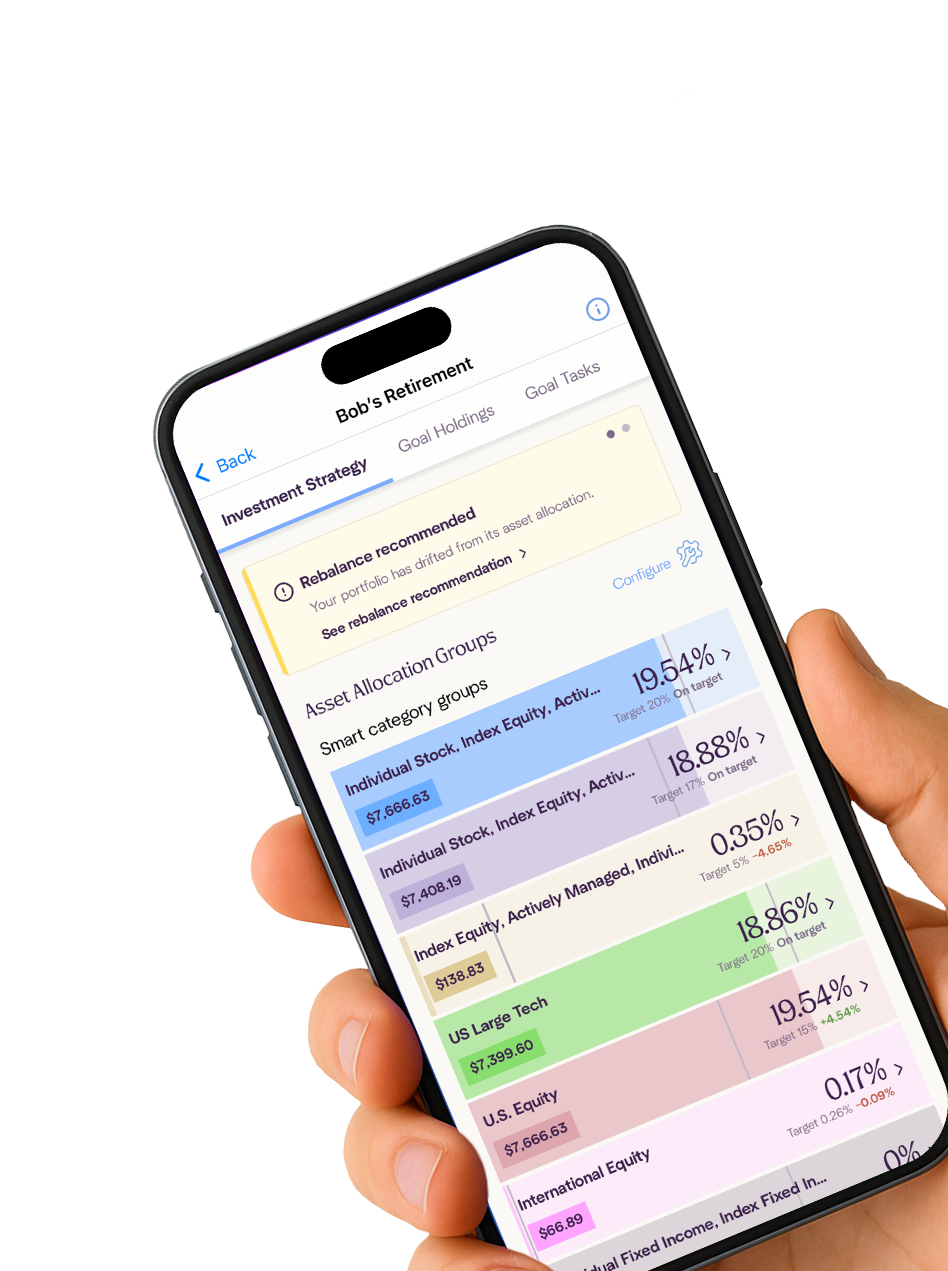
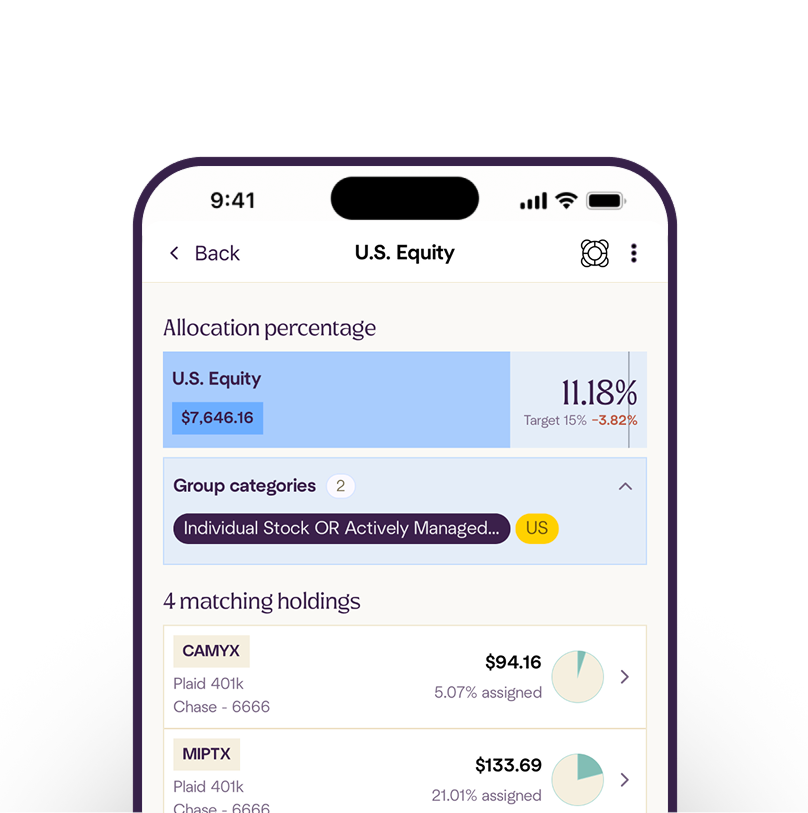
- Designed specifically for US DIY investors with multiple brokerage accounts, retirement accounts, and 529 accounts who want to see their true asset allocation across accounts against a goal‑specific plan, not just a single pie chart per account.
- Highly customizable asset allocation: build your own allocation using your own defined set of factors, or choose from a library of allocations. Use a look-through analysis of your portfolio to identify over- or under-exposure.
- Checks and proactively alerts you to rebalance opportunities, idle cash, potential tax‑loss harvesting candidates, goal-on-or-off-track status changes, and asset‑location questions across accounts.
- Produces trade instruction checklists and rebalance plans you can take to your existing brokers, so you stay in control of trades while reducing portfolio busywork and guesswork.
- Enrich is not a money‑movement app or robo‑advisor; it does not take custody of assets, manage portfolios, or place trades, so you still need to execute at your broker.
- It focuses on portfolio oversight and maintenance rather than budgeting, cash‑flow tracking, or full financial planning, so you may still want a separate tool for day‑to‑day money management.
- It’s currently iOS‑only for US users and is built for people who already have, or are willing to set, a target allocation and a goal structure; if you want a “do everything for me” solution, this is not that.
How to pick a portfolio tracker in about 10 minutes


- “I just want to see everything in one place.” → Start with Empower or a similar free dashboard.
- “I want a clean, flexible net worth and portfolio view, and I’m willing to pay for it.” → Look at Kubera.
- “I care a lot about performance, dividends, and tax reports on my securities.” → Try Mezzi.
- “I want to dissect what’s inside my funds.” → Use SigFig.
- “I want to manage my asset allocation across accounts.”→ Use Enrich.

- A true cross‑account allocation view that lines up against the rules you set, not a generic “here’s your pie chart.”
- Checks for drift, idle cash, tax‑loss harvesting candidates, and asset location questions across accounts, so you can decide what to act on.
- Plain‑English checklists that translate those findings into possible trades or changes you can choose to make with your broker.


.png)


Dashboards are good at showing you where you are. They’re less good at quietly tapping you on the shoulder when something in the plan has drifted.
Research suggests that thoughtful asset allocation, periodic rebalancing, tax‑aware practices, and clear goal‑based planning can add up to meaningful differences for some investors over time, but results vary, and there are no guarantees.234 Enrich helps you keep an eye on those maintenance jobs with less time in spreadsheets, while you stay in control of what actually happens in your accounts.
Which one is right for you?
Where do these dashboards stop helping
If you notice a theme, it’s this: most mainstream portfolio trackers either focus on the big picture (net worth and basic allocation) or on deep performance analytics and fee optimization.
Very few are built to run a passive, asset allocation-based strategy. Studies have found that thoughtful asset allocation, periodic rebalancing, and tax‑aware practices can add up to meaningful differences in long‑term outcomes for some investors, although results vary and there are no guarantees.1
Sidebar: A portfolio’s asset allocation drives ~90% of your portfolio’s behavior over time, not stock picking or market timing (source). According to Brinson, Hood, Beebower’s paper (Determinants of Portfolio Performance, Financial Planning Journal, 1985-1994), implementing an asset allocation strategy can be the deciding factor between achieving your goals on time or not.
Why spreadsheets don’t cut it
If you’ve got more than one investing account, more than likely your broker’s dashboard is only telling you part of the story. So you started logging into each of your brokerage accounts and copying and pasting their values into a spreadsheet. But it's cumbersome. You want something that lets you see balances and recent performance. You want to see your true asset mix across accounts, or whether your taxes and goals are quietly drifting off plan. You probably need a portfolio tracker.
This guide walks through portfolio trackers that help serious DIY savers keep multiple accounts in one view, then shows where a dedicated “portfolio intelligence” layer can help with rebalancing alerts, tax‑loss opportunities, and goal tracking.


If you’re further along in your journey, you might also want:

Common mistakes when switching trackers
Chasing every feature: more toggles don’t mean better decisions; pick the one or two jobs you want the tool to handle.
Expecting tax tools to be magic: tax‑loss harvesting and asset location can help, but they involve tradeoffs, and what’s “best” depends on your full tax picture.
Letting alerts pile up: the best tracker or intelligence tool for you is the one whose nudges you’ll actually check and use.
If you get the basics right—seeing your true asset mix across accounts and keeping an eye on key maintenance jobs—you’re already ahead of most people with five tabs open and no clear plan.
Invest with Confidence. Anywhere. Anytime.
Join investors already using Enrich Finance to optimize their rebalancing strategy.